
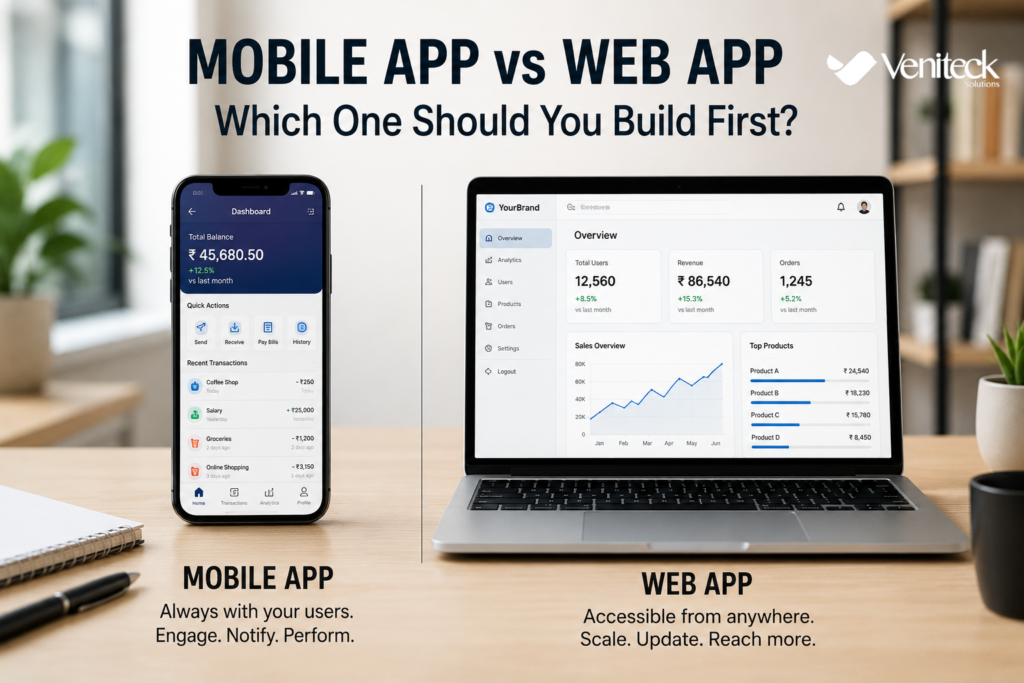
Every founder eventually sits across the table from a developer or a co-founder and asks the same question: Should we build a mobile app or a web app first? It feels like a small technical detail in the beginning, but it is actually one of the biggest decisions you will make for your business. The choice between a mobile app and a web app affects your budget, your timeline, how fast you can reach customers, and even how investors view your product in the early stages. If you have been going back and forth on this, you are definitely not alone, and by the end of this blog, you will have a clear answer based on where your business actually stands today.
Let’s break this down properly, without the jargon, so that you can make a decision you are actually confident about.
What Exactly Is the Difference
Before deciding anything, it helps to understand what each option really means in practical terms.
A web app is something your customers open directly through a browser, using a simple link, no downloading, no installing, no waiting. You build it once, and it works on a laptop, a tablet, or a phone, all from the same codebase. Web app development is generally faster and more budget-friendly because your team is not maintaining two completely separate versions of the product.
A mobile application, on the other hand, is always present on a person’s device. The client accesses it from the Play or App stores, installs it, and keeps it there as an icon to click anytime he wants. With mobile applications, it is possible to get what a browser does not provide: notifications,r camera functionalities, GPS support, offline support, and faster performance.
Neither one is “better” in a universal sense.
They solve different problems, and the right choice depends entirely on what your business needs right now, not what sounds more impressive.
What Web Apps Do Better
Web apps have several advantages that make them the right starting point for many businesses, particularly those building for the first time.
Lower development cost and faster launch. A web app has one codebase. A native mobile app requires separate development for iOS and Android, or a cross-platform framework that adds its own complexity. For businesses working with limited budgets and timelines, a web app reaches users significantly faster and for significantly less. Mobile app development cost for a native dual-platform app is typically two to three times higher than an equivalent web app.
No app store approval process. Publishing to the App Store and Google Play involves review processes that take time and can be unpredictable. Updates to a web app are live immediately. For early-stage products where rapid iteration is essential, testing features, responding to user feedback, and fixing issues quickly is a meaningful advantage.
Accessible to everyone with a browser. Web apps don’t require a download commitment from users. Someone who encounters your product through a search result or a shared link can start using it immediately, with zero friction. For B2B products, especially, where users are often on desktop and the barrier to trying something new needs to be low, web apps are the natural fit.
Easier SEO and discoverability. Search engines index web app content. Your product or platform can be found organically through Google. Search engines do not index a native mobile app — the only way to discover it is through the app stores or someone sharing the link directly.
What Mobile Apps Do Better
Custom mobile app development wins in situations where the nature of the product genuinely requires what only a mobile environment can provide.
Access to device hardware. If your product needs the camera, GPS location, accelerometer, NFC, Bluetooth, biometric authentication, or push notifications, a native or near-native mobile app is the right choice. A web app can access some of these via browser APIs, but the experience is more limited and less reliable than native access.
Offline functionality. Mobile applications have the ability to save data locally, and they work without requiring an internet connection, syncing when connectivity is established again. This feature is critical in applications used in environments with unstable internet connections, such as logistics and delivery applications.
Push notifications. The ability to reach users proactively on their device, on their terms, at the right moment, is one of the most powerful engagement tools a mobile app has. Web push notifications exist but are significantly less effective in terms of reach and reliability than native push.
Performance for complex, interaction-heavy experiences. Native mobile apps can be faster and smoother for highly interactive experiences, games, augmented reality, complex real-time data visualisations, than web apps running in a browser.
Higher engagement and retention for consumer products. Research consistently shows that users engage more deeply and more frequently with apps they’ve downloaded than with websites they visit. For consumer products where daily or weekly engagement is the goal, the download commitment that comes with a mobile app is actually an asset, as users who download are more invested.
Why This Decision Feels So Difficult
Most founders get stuck here because they are thinking about the destination instead of the journey. Everyone wants a slick mobile app with notifications popping up and a permanent spot on a customer’s home screen. But very few businesses are actually ready for that on day one.
The issue here is not whether one is better than the other. The issue is how you can quickly get your message to customers without wasting your marketing budget. This is when an objective evaluation of your circumstances, budget, target market, and goals is more important than your personal preference.
The Case for Starting With a Web App
If you are an early-stage startup trying to figure out whether your idea even works, a web app is almost always the smarter starting point.
Here is why. Custom web app development typically costs significantly less than building a native mobile application, mainly because you are working with a single codebase instead of separate builds for iOS and Android. You also skip the entire app store approval process, which can delay a launch by days or even weeks if your submission gets rejected on the first try, something that happens to a large percentage of new apps.
There is another advantage that founders often overlook. A web app is something Google can actually index and rank. People searching for solutions on Google land on websites, not app store listings. If your business depends on people discovering you through search, a web app gives you that visibility from day one. In contrast, a native app remains essentially invisible until someone already knows to look for it in an app store.
Updating a web app is also far simpler. You push a change, and every single user sees the new version the next time they refresh the page. No waiting for app store review. No asking users to update anything manually. This kind of speed matters enormously when you are still testing what works and what does not.
When a Mobile App Actually Makes Sense First
There are situations where jumping straight to mobile app development is genuinely the right call, and it usually comes down to what your product actually depends on to function.
If your application is dependent on real-time geolocation, cameras, biometric authentication, or always-on push notifications, which make it engaging for the user, then the web can never be as effective at providing that level of engagement. Consider applications such as ride-hailing apps, which use real-time GPS services, or fitness trackers that track your movements through the day. These are core components of the app, without which the app itself becomes meaningless.
Mobile apps also tend to build stronger long-term engagement once a user has committed to downloading them. An icon sitting on someone’s home screen, paired with the ability to send a notification directly to their lock screen, creates a level of stickiness that a website bookmark cannot match. If customer retention and daily engagement are central to your business model, that pull toward native app vs web app conversations starts leaning more seriously toward mobile.
What About Cost
This is usually the first question every founder actually wants answered, so let’s be direct about it.
Mobile app development costs generally run higher than web app development, and the gap is not small. A reasonably built native app can require a meaningfully larger investment than a comparable web application, especially once you factor in the need to build and maintain separate versions for iOS and Android, plus the ongoing cost of app store fees and ecosystem changes.
Web apps cost less primarily because there is one codebase, one deployment process, and no commission fees being taken out by app store platforms. App stores can take a significant cut of in-app revenue, which is worth remembering if your business model depends on transactions happening inside the app itself.
This does not mean cost should be the only factor in your decision, but for most early-stage businesses working with a limited runway, it is usually the deciding one.
The Smartest Approach Most Successful Companies Actually Use
Here is something that rarely gets said clearly enough: the smartest businesses do not really choose one over the other. They sequence them.
The typical pattern looks like this. Launch with a web app first to validate that people genuinely want what you are building. Use that period to understand your actual users, gather feedback, and figure out which features matter and which ones do not. Once you have real traction, real revenue, and a clear sense of what your most engaged users want, that is when investing in a native mobile app starts to make financial and strategic sense.
This approach protects you from the worst possible outcome, spending a large chunk of your budget on a polished mobile app before you even know if your business idea resonates with anyone.
Working With the Right App Development Company
Whatever path you select, the developers who will build your product are just as important as the platform itself. An experienced app developer will probe you thoroughly before even considering writing a line of code, regarding who the product is designed for, what your financial standing is, what the future holds, and what success means for you within the next year.
If you are based in India and exploring software development solutions locally, working with an app development company in Bangalore gives you the advantage of in-person collaboration combined with access to experienced talent at a more reasonable cost compared to many Western markets. Whether you ultimately need custom mobile app development or want to start lean with a web build, the right development partner will guide you toward the option that actually fits your stage of business, not the one that sounds most impressive on paper.
Making Your Final Decision
If you take nothing else away from this blog, remember this. The mobile app vs web app decision is not about which technology is trendier. It is about matching your platform choice to where your business actually is right now.
If you are still validating your idea, working with a tight budget, or need to move fast and get discovered through search, start with a web app. If your product genuinely depends on device-level features like GPS, camera access, or constant notifications to function properly, mobile app development is worth the higher investment from the start.
And if you are unsure which category you fall into, that uncertainty itself is usually a sign that a web app is the safer, smarter first move.
Frequently Asked Questions
Q1. What is the difference between a mobile app and a web app?
A web app runs in a browser with no download required, while a mobile app is installed on a phone. Web apps are faster and lower cost to build, while mobile apps offer access to device features like GPS and notifications.
Q2. Should startups build mobile apps first?
Not always. Most startups begin with a web app to launch faster, validate demand, and reduce development costs before investing in mobile apps.
Q3. Are web apps cheaper than mobile apps?
Yes. Web apps usually cost less because they use one codebase across devices, while mobile apps often require separate development for iOS and Android.
Q4. Which is better: mobile app or web app?
Neither is better for every case. Web apps suit speed and affordability, while mobile apps work well for engagement and device-based experiences.
Q5. When should businesses choose web apps?
Choose a web app if you need a quicker launch, lower budget, search visibility, or want to test your business idea first.
Q6. Is mobile app development more expensive than web app development?
Yes. Mobile apps generally involve higher build and maintenance costs due to platform-specific development and app store requirements.
Q7. Which performs better: native app or web app?
Native apps usually deliver faster performance and smoother experiences. Web apps work well for most business use cases and are easier to maintain.
Q8. Do I need a software development company to build an app?
Simple apps can use no-code tools, but businesses often benefit from a development partner to choose the right platform and avoid costly mistakes.