
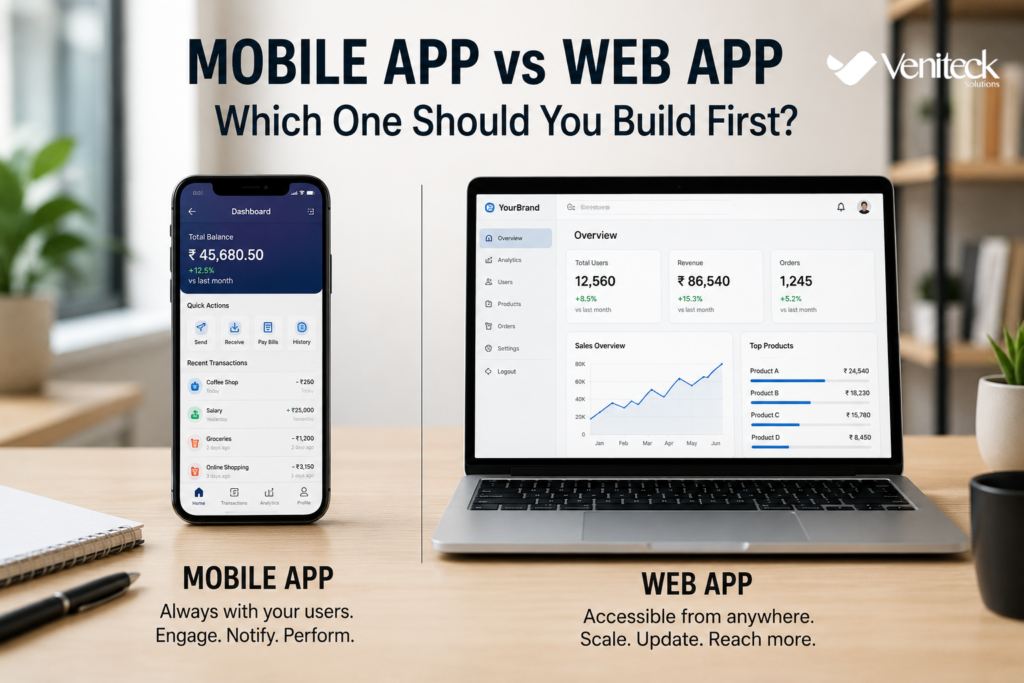
Mobile App vs Web App: Which One Should You Build First?
Every founder eventually sits across the table from a developer or a co-founder and asks the same question: Should we build a mobile app or a web app first? It feels like a small technical detail in the beginning, but it is actually one of the biggest decisions you will make for your business. The choice between a mobile app and a web app affects your budget, your timeline, how fast you can reach customers, and even how investors view your product in the early stages. If you have been going back and forth on this, you are definitely not alone, and by the end of this blog, you will have a clear answer based on where your business actually stands today. Let’s break this down properly, without the jargon, so that you can make a decision you are actually confident about. What Exactly Is the Difference Before deciding anything, it helps to understand what each option really means in practical terms. A web app is something your customers open directly through a browser, using a simple link, no downloading, no installing, no waiting. You build it once, and it works on a laptop, a tablet, or a phone, all from the same codebase. Web app development is generally faster and more budget-friendly because your team is not maintaining two completely separate versions of the product. A mobile application, on the other hand, is always present on a person’s device. The client accesses it from the Play or App stores, installs it, and keeps it there as an icon to click anytime he wants. With mobile applications, it is possible to get what a browser does not provide: notifications,r camera functionalities, GPS support, offline support, and faster performance. Neither one is “better” in a universal sense. They solve different problems, and the right choice depends entirely on what your business needs right now, not what sounds more impressive. What Web Apps Do Better Web apps have several advantages that make them the right starting point for many businesses, particularly those building for the first time. Lower development cost and faster launch. A web app has one codebase. A native mobile app requires separate development for iOS and Android, or a cross-platform framework that adds its own complexity. For businesses working with limited budgets and timelines, a web app reaches users significantly faster and for significantly less. Mobile app development cost for a native dual-platform app is typically two to three times higher than an equivalent web app. No app store approval process. Publishing to the App Store and Google Play involves review processes that take time and can be unpredictable. Updates to a web app are live immediately. For early-stage products where rapid iteration is essential, testing features, responding to user feedback, and fixing issues quickly is a meaningful advantage. Accessible to everyone with a browser. Web apps don’t require a download commitment from users. Someone who encounters your product through a search result or a shared link can start using it immediately, with zero friction. For B2B products, especially, where users are often on desktop and the barrier to trying something new needs to be low, web apps are the natural fit. Easier SEO and discoverability. Search engines index web app content. Your product or platform can be found organically through Google. Search engines do not index a native mobile app — the only way to discover it is through the app stores or someone sharing the link directly. What Mobile Apps Do Better Custom mobile app development wins in situations where the nature of the product genuinely requires what only a mobile environment can provide. Access to device hardware. If your product needs the camera, GPS location, accelerometer, NFC, Bluetooth, biometric authentication, or push notifications, a native or near-native mobile app is the right choice. A web app can access some of these via browser APIs, but the experience is more limited and less reliable than native access. Offline functionality. Mobile applications have the ability to save data locally, and they work without requiring an internet connection, syncing when connectivity is established again. This feature is critical in applications used in environments with unstable internet connections, such as logistics and delivery applications. Push notifications. The ability to reach users proactively on their device, on their terms, at the right moment, is one of the most powerful engagement tools a mobile app has. Web push notifications exist but are significantly less effective in terms of reach and reliability than native push. Performance for complex, interaction-heavy experiences. Native mobile apps can be faster and smoother for highly interactive experiences, games, augmented reality, complex real-time data visualisations, than web apps running in a browser. Higher engagement and retention for consumer products. Research consistently shows that users engage more deeply and more frequently with apps they’ve downloaded than with websites they visit. For consumer products where daily or weekly engagement is the goal, the download commitment that comes with a mobile app is actually an asset, as users who download are more invested. Why This Decision Feels So Difficult Most founders get stuck here because they are thinking about the destination instead of the journey. Everyone wants a slick mobile app with notifications popping up and a permanent spot on a customer’s home screen. But very few businesses are actually ready for that on day one. The issue here is not whether one is better than the other. The issue is how you can quickly get your message to customers without wasting your marketing budget. This is when an objective evaluation of your circumstances, budget, target market, and goals is more important than your personal preference. The Case for Starting With a Web App If you are an early-stage startup trying to figure out whether your idea even works, a web app is almost always the smarter starting point. Here is why. Custom web app development typically costs significantly less than building a native mobile application, mainly because you are working