
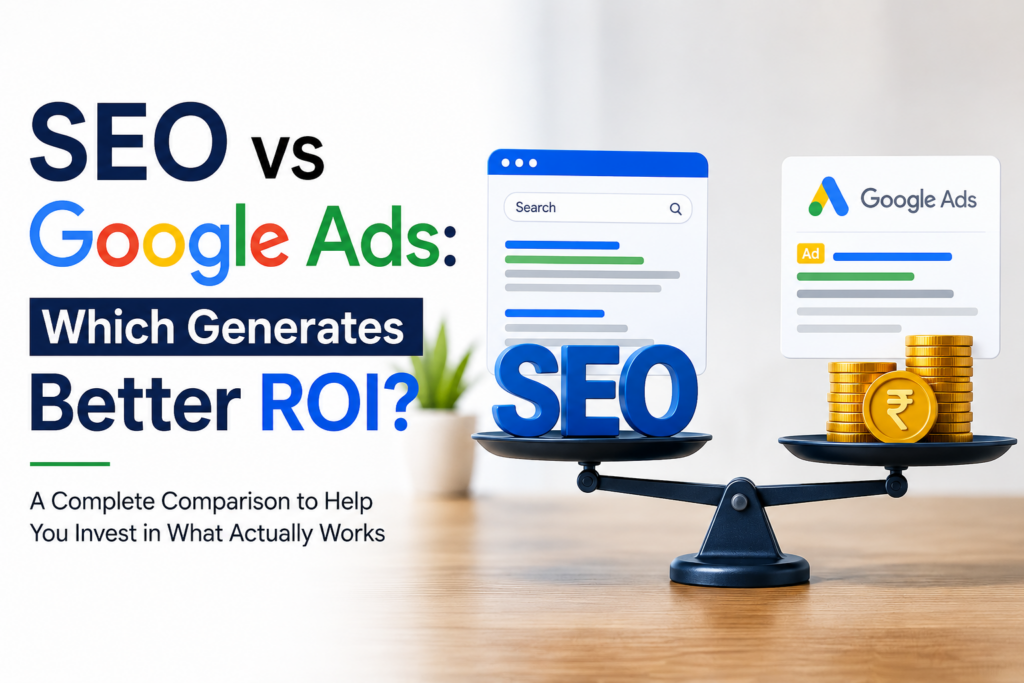
If there’s one question that comes up in almost every digital marketing conversation with business owners in India, it’s this one. SEO vs Google Ads, where should the budget actually go? The frustrating reality is that there’s no single answer that applies to every business, every industry, and every growth stage. But there is a framework for thinking about it clearly — one that goes beyond the usual “SEO is cheaper long-term” vs “Google Ads are faster” oversimplification and actually helps you make a decision that’s right for your specific situation. No matter whether you are a startup looking for your first clients, an already existing company seeking growth, or an established brand engaged in an SEO vs PPC battle at once and having doubts about the ratio of the budgets spent on both channels, here you can find the most sincere comparison.
First – What Are We Actually Comparing?
Before getting into ROI, it helps to be precise about what each channel is and how it works.
Search Engine Optimization is the practice of improving your website’s content, structure, and authority so that it ranks higher in organic search results for relevant queries. When someone searches “best dental clinic in Bangalore” or “IoT development company India”, and your website appears in the results without you paying for that specific click, that’s SEO at work. The investment is in content, technical website improvements, and link building — not in individual clicks.
Google Ads (previously called Google AdWords) is a paid advertising platform where you bid to have your website or landing page appear at the top of search results for specific keywords. You define your keywords, set your bids, write your ads, and pay each time someone clicks. Google Ads cost per click 2026 varies dramatically by industry — from a few rupees for low-competition keywords to several hundred rupees per click in highly competitive sectors like finance, legal, or insurance.
These two channels are not interchangeable — they work differently, produce results at different speeds, and suit different business situations. The question of which generates better ROI cannot be answered without understanding what ROI actually looks like in each channel.
How ROI Works Differently in SEO and Google Ads
This is the part of the conversation that most blog posts skip over and it’s the most important part.
Google Ads ROI is immediate and measurable. You spend money today, you get clicks today, some of those clicks convert into leads or customers, and you can calculate your cost per acquisition with reasonable precision. If you spend ₹50,000 on Google Ads in a month and generate ₹200,000 in revenue from those campaigns, the ROI calculation is straightforward. This clarity is one of the most appealing things about paid advertising — you can see exactly what you’re getting for each rupee spent.
But the moment you stop spending, the results stop. There is no residual value from last month’s Google Ads spend. Every new month requires fresh investment to maintain traffic and leads.
SEO for business growth works on a completely different ROI model. The investment is front-loaded — you invest in content, technical optimization, and authority building over months before organic traffic builds to meaningful levels. But once that traffic is established, it continues generating results without incremental cost per click. A blog post that ranks on page one today can continue delivering traffic and leads for years, with no additional spend required for each individual visitor.
The SEO ROI curve looks flat or negative in the early months and then compounds dramatically over time. The Google Ads ROI curve is more linear — spend more, get more proportionally — but stops completely when the budget stops.
Neither model is inherently superior. The right model depends on where your business is right now and what kind of returns you need on what timeline.
Which Gives Faster Results : SEO or Google Ads?
This one is straightforward. How long does SEO take vs Google Ads to produce results is not a close comparison.
Google Ads can produce traffic and leads within hours of a campaign going live. There’s no waiting period, no building phase, no domain authority requirement. You set up the campaign, it gets approved, and clicks start arriving.
SEO takes time — and how much time varies significantly depending on the competitiveness of your keywords, the current state of your website, the quality of your content, and how aggressively you’re building authority. For most businesses in India, starting from scratch or with limited existing SEO investment, meaningful organic traffic typically takes 4 to 9 months to build. Competitive industries or keywords in major cities can take longer.
This time difference matters enormously for businesses at different stages. A business that opened last month and needs customers now cannot wait 6 months for SEO to deliver. A business with a 3-year runway and a focus on building sustainable, scalable customer acquisition cannot afford to be entirely dependent on a paid channel forever.
The timing reality is one of the clearest reasons why the digital marketing strategy that most experienced practitioners recommend for growing businesses involves both channels — paid to generate immediate results while organic builds in the background.
The Cost Comparison: What Are You Actually Paying?
SEO vs paid advertising comparison on cost is more nuanced than it first appears.
Google Ads costs are visible and immediate — you know exactly what you’re spending per click and per campaign. In competitive Indian markets, clicks for commercial intent keywords can range from ₹30 to ₹500 or more, depending on the industry. For a business in a competitive sector running meaningful ad volume, monthly ad spend can quickly reach ₹1 lakh or more — every month, indefinitely.
While SEO expenses may not be as obvious, they are nonetheless very much tangible. Paid-for SEO services entail content creation, web design and development, link building, and optimization. The minimum monthly amount required to invest in SEO in order to compete effectively can range between ₹30,000 and ₹2 lakhs per month.
The critical difference is what happens to the investment over time. Ad spend stops producing the moment it stops flowing. SEO investment accumulates — content published 18 months ago is still ranking, still generating traffic, still contributing ROI without additional cost for each visit.
During 3 years, organizations that have steadily made use of SEO see their cost per organic lead fall steadily, but their cost per paid lead stays fairly stable. The point of crossover, which is the point at which SEO becomes a more efficient method than paid advertising, normally comes in at around the 18 to 36-month mark.
SEO vs Google Ads: Which Is Better for Business
The right answer genuinely varies by industry, and here’s how to think about it:
Industries where Google Ads tends to outperform:
High-urgency, transactional searches — emergency services, same-day delivery, event-specific products. When someone is searching for something they need right now and price-comparing multiple providers in a single session, paid ads with strong landing pages often convert better than organic results.
Highly competitive organic landscape — industries where the top organic positions are occupied by established national brands or platforms with enormous domain authority. For a new business in such an industry, paid traffic may be the only realistic way to generate leads while organic authority is being built.
Short product cycles or seasonal businesses — where traffic spikes are predictable, and the business doesn’t need a year-round organic presence.
Industries where SEO tends to outperform:
Informational and research-driven buying journeys — where potential customers spend weeks or months researching before purchasing. B2B services, professional services, education, and healthcare. The content that answers research questions, establishes expertise, and builds trust over a longer customer journey performs consistently well in organic search.
AI search optimization is also increasingly relevant here, as AI Overviews in Google draw from high-quality informational content; businesses with strong SEO and content programmes are getting additional visibility through AI-generated summaries, a channel that paid advertising cannot access.
Businesses with tight ad budgets and competitive keyword costs — where the cost per click in paid channels is high relative to the value of a typical customer, making sustainable ROI from ads difficult to achieve.
Is Google Ads Worth It in 2026?
Yes, but with important qualifications.
Google Ads in 2026 is more expensive in most categories than it was five years ago, as more businesses have moved significant budgets to paid search. Google Ads management has also become more complex — effective campaigns require sophisticated audience targeting, conversion tracking, landing page optimization, and continuous bid management. The days of setting up a simple keyword campaign and getting cheap, high-quality traffic are largely gone in competitive markets.
To achieve a genuine return on investment (ROI) with PPC advertising services in 2026, you should have clear conversion tracking, an effective landing page experience, enough budget to get out of the learning stage within a realistic amount of time, and campaign management by an active and knowledgeable individual.
Businesses that run Google Ads without these elements in place typically find the returns disappointing — not because paid advertising doesn’t work, but because it requires more sophistication than it used to in order to generate profitable results.
Does SEO Generate Better ROI Than Google Ads
For most businesses with a time horizon of 2 years or more, yes — SEO generates better long-term ROI than Google Ads in most scenarios. The compounding nature of organic authority, the declining cost per lead over time, and the sustainability of organic traffic without continuous ad spend all contribute to a cumulative ROI that paid advertising cannot match over a long enough period.
But the honest qualification is that this only holds when SEO is implemented properly — with high-quality content, technically sound website architecture, genuine authority building, and consistent investment over time. Poorly executed SEO — thin content, keyword stuffing, low-quality links — doesn’t compound. It stagnates or actively damages organic performance.
The comparison also changes when you account for the immediate revenue a business needs to sustain itself during the period that SEO is building. Many businesses cannot survive a 6 to 12-month period of minimal organic traffic while they build authority. In these cases, Google Ads provides the immediate revenue that funds the business while SEO builds a sustainable channel for the future.
The Most Effective Answer: Use Both, Strategically
This is where experienced digital marketing company Bangalore practitioners consistently land after years of managing both channels for clients: the question of SEO vs Google Ads is less useful than the question of how to use each channel for what it’s best suited for.
Paid advertising to generate leads quickly, test messages, capture high-intent commercial search terms, and fill in the gaps while building organics. SEO to build sustainable, compounding, cheaper traffic over time, content that positions authority and captures buyers at the research stage.
The budget split between these two channels should shift over time — heavier on paid in the early stages, shifting progressively toward organic investment as the website builds authority and organic traffic grows.
Veniteck Solutions is a digital marketing company in Bangalore with 13+ years of experience managing integrated digital marketing strategies — combining SEO, PPC, content marketing, and AI search optimization into coherent programmes that serve specific business growth objectives. Whether your immediate priority is fast lead generation through paid campaigns, building organic authority through SEO, or developing an integrated strategy that evolves with your business, the team at Veniteck brings both the technical capability and the strategic perspective to make it work.
FAQ
Q1. Which is better for a business SEO or Google Ads?
Google Ads delivers faster results, while SEO builds stronger long-term growth. Many businesses get the best outcome by using both.
Q2. Does SEO generate better ROI than Google Ads?
Over time, SEO often delivers stronger ROI because organic traffic does not require ongoing ad spend.
Q3. How long does SEO take compared to Google Ads?
Google Ads can generate results quickly, while SEO usually takes 4–9 months to build meaningful traffic.
Q4. Is SEO or Google Ads better for small businesses?
Small businesses needing quick leads often choose Google Ads, while SEO supports sustainable long-term growth.
Q5. How much does Google Ads cost per click in India in 2026?
CPC varies by industry and competition, ranging from around ₹10 to ₹500+ per click.
Q6. Can SEO and Google Ads work together?
Yes. Google Ads creates immediate visibility while SEO builds long-term traffic and lower acquisition costs.
Q7. What is AI search optimization and how does it affect SEO in 2026?
AI search optimization helps content appear in AI-generated search results through clear, structured, and helpful information.
Q8. How do I find a good digital marketing company in Bangalore for SEO and Google Ads?
Choose a company with proven results, transparent reporting, and experience managing both SEO and paid campaigns.