
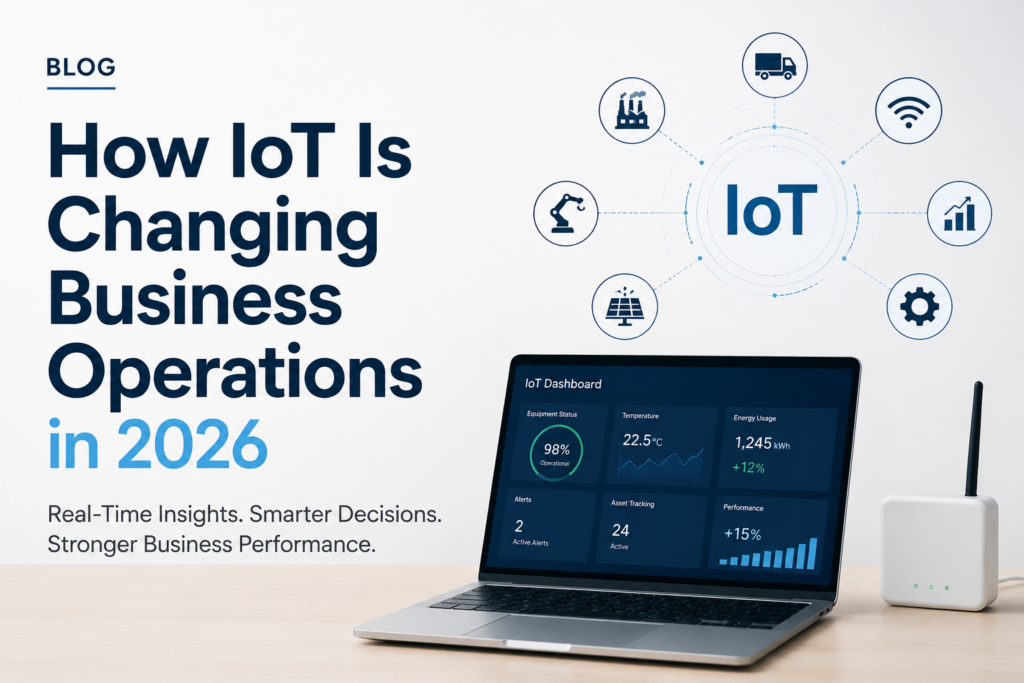
There’s a quiet revolution happening inside businesses across India and globally — and most of it is invisible to the people outside those organisations. Machines talking to each other. Sensors send real-time alerts before equipment fails. Inventory levels are updated automatically without anyone counting. Energy systems adjust themselves based on occupancy. All of this is IoT development in practice, and in 2026, it has moved decisively from a pilot project category into mainstream business infrastructure. If you run a business in India and you’re still thinking of IoT as something futuristic or primarily relevant to large multinationals, this blog is going to change that perspective. IoT business operations in 2026 are real in the sense that there is a ready technology, there are defined use cases, and the companies that are ahead are those that were already connecting their operations way back then.
What IoT Actually Is
Before getting into how it’s changing business operations, it helps to be clear about what IoT actually means in practical terms.
IoT is the Internet of Things. It includes physical devices, machines, appliances, and systems that are connected to the internet and can send and receive information. Here, the “things” in IoT are physical things from the real world. The “internet” part is what connects them to software systems that can process and act on the data they generate.
In a business context, this means physical assets — a piece of manufacturing equipment, a delivery vehicle, a temperature-controlled storage unit, a building’s HVAC system — can be monitored, controlled, and automated in ways that were previously impossible without significant manual effort.
The value created by this connectivity is enormous — and it falls into a few consistent categories: knowing things you previously didn’t know, responding to situations faster than before, and automating processes that previously required human intervention.
How Businesses Use IoT in 2026
The question isn’t whether IoT has business applications. It’s about which applications are most relevant to your specific industry and operational context. Here’s an honest picture of where IoT is actually delivering measurable results for Indian businesses in 2026.
Manufacturing
Manufacturing is where IoT ROI is most clearly measurable and where adoption has moved fastest. IoT for manufacturing and logistics applications includes:
Sensors mounted on production equipment — motors, compressors, CNC machines, conveyor systems — continuously monitor vibration, temperature, pressure, and current draw. Machine learning models trained on this sensor data identify the early signatures of mechanical wear or imminent failure — often days or weeks before the equipment would break down. Maintenance is scheduled based on actual equipment condition rather than fixed calendar intervals, dramatically reducing both unplanned downtime and unnecessary preventive maintenance costs.
Monitoring in the production process gives real-time feedback on how fast production is being carried out and how good the quality is. If one stage in the production process fails or some quality problem arises, the software will pick it up right away.
For Indian manufacturers competing on both quality and cost, the operational advantages of connected production monitoring are significant — and increasingly necessary to maintain competitiveness.
Logistics and Supply Chain
Supply chain management has historically involved significant blind spots — periods when goods are in transit, and nobody knows exactly where they are, what condition they’re in, or whether they’re on schedule.
The use of IoT-connected location trackers installed on vehicles or packages gives logistics managers real-time location information that helps resolve this ambiguity. Temperature sensors in a refrigerated truck or package ensure continuous monitoring of temperature conditions, which triggers an immediate alert to the logistics manager in case of any breach of the cold chain, unlike finding out the problem at the destination. The ability of geofencing ensures that the delivery time windows are managed precisely.
For the logistics firms and supply chain managers in India, where unpredictable routes and varied infrastructure present genuine issues, real-time visibility is no longer an unnecessary function but a requirement for success.
Retail and Inventory
Inventory management in retail has traditionally involved a trade-off between accuracy and the cost of achieving it. Manual stock counts are time-consuming, infrequent, and inevitably contain errors. The gap between what the inventory system says is in stock and what is actually on the shelf creates ordering errors, stockouts, and lost revenue.
IoT-enabled inventory management — using RFID tags, weight sensors on shelving, or smart storage systems — tracks inventory levels in real time without manual counting. The system knows when stock is running low and can trigger automatic reorder processes. Shrinkage and discrepancy detection become continuous rather than periodic.
For retail businesses in India managing high SKU counts across multiple locations, the efficiency and accuracy gains from IoT inventory management are substantial.
Energy Management
Energy costs are a significant operational expense for businesses across industries, and IoT-based energy management is delivering consistently measurable reductions in consumption without impacting operational comfort or productivity.
Smart energy monitoring systems track consumption by zone, department, or piece of equipment in real time — providing granular visibility into where energy is being used. Automated controls adjust lighting, HVAC, and equipment operation based on occupancy, time of day, and production schedules. Anomaly detection identifies equipment that is consuming more energy than expected — often an early indicator of maintenance issues.
For Indian businesses where energy costs represent a meaningful proportion of operating expenses, smart energy management typically delivers ROI within months.
Benefits of IoT in Business – What the Data Consistently Shows
Across industries, the measurable business benefits of IoT implementation follow consistent patterns.
Operational cost reduction. Predictive maintenance reduces unplanned downtime costs. Automated processes reduce labour costs for manual monitoring and data collection. Energy optimisation reduces utility expenses. The cumulative effect on operating costs is significant for businesses with meaningful physical operations.
Faster decision-making. When operational data is available in real time rather than in weekly or monthly reports, managers can make decisions based on current reality rather than historical summaries. This speed advantage compounds — problems are identified and addressed earlier, opportunities are recognised and acted on faster.
Quality improvement. Continuous monitoring of production processes, environmental conditions, and equipment performance allows quality issues to be detected and addressed at the point of occurrence rather than after they’ve affected a batch of products or a customer shipment.
Asset utilisation improvement. Understanding exactly how assets are being used — when equipment is idle, when vehicles are running below capacity, when floor space is underutilised — allows businesses to make better decisions about asset deployment and investment.
IoT Security Cybersecurity – The Challenge That Must Be Addressed
Any honest discussion of IoT in 2026 must include a direct acknowledgement of the security dimension — because connected devices that aren’t properly secured represent a genuinely significant risk.
Every device connected to the internet is a potential entry point for malicious actors. IoT devices — sensors, cameras, connected equipment — often run simplified operating systems that are harder to update and patch than conventional computers. When an IoT network is deployed without adequate security architecture, the devices that are supposed to improve operational visibility can become vulnerabilities that compromise it.
Some of the important security considerations that should be adhered to when deploying the IoT responsibly are:
– Device authentication to allow only authorized devices to join the network;
– Encrypted communication to prevent data theft in transit;
– Firmware updating to fix any detected weaknesses in the device’s software;
– Network segmentation to protect other business systems from IoT devices in case of compromise;
– Monitoring for any abnormal network activity.
For businesses in India deploying IoT for the first time, working with an implementation partner who treats security as a foundational design requirement rather than an afterthought is not optional — it’s the difference between an IoT deployment that creates value and one that creates risk.
IoT Implementation for Small Businesses
One of the most persistent misconceptions about IoT is that it’s primarily for large enterprises with significant technology budgets. The reality in 2026 is considerably more accessible.
Cloud-based IoT platforms have reduced the infrastructure investment required to get started. Standard hardware components — sensors, connectivity modules, gateway devices — are more affordable than they have ever been. Implementation partners with experience in small and medium business deployments can scope solutions that deliver meaningful ROI without requiring enterprise-scale investment.
The practical starting point for a small business in India exploring IoT is identifying a specific, well-defined operational problem where better data would clearly lead to better outcomes. A manufacturing SME might start with predictive maintenance on its three most critical pieces of equipment. A logistics company might start with real-time tracking on its delivery fleet. A retail business might start with inventory management for its highest-turnover product categories.
Starting focused and demonstrating clear ROI on a contained deployment is the most reliable path to broader IoT adoption — and the most common approach taken by businesses that successfully scale from pilot to integrated operation.
IoT Application Development – Building for Your Specific Needs
Off-the-shelf IoT products work well for generic use cases — standard temperature monitoring, basic asset tracking, simple energy management. But many of the highest-value IoT opportunities in business involve specific operational contexts that generic products don’t fully address.
Custom IoT software development bridges this gap — creating the data pipelines, integration layers, dashboards, and alerting systems that connect your specific devices to your specific business processes in a way that creates the most value. This might mean integrating IoT sensor data into your existing ERP system so that maintenance alerts automatically create work orders. It might mean building a custom dashboard that gives your production manager exactly the operational view they need without requiring them to navigate a generic platform. It might mean developing automated response logic that triggers specific actions when specific conditions are met.
The quality of this custom development layer — how well it connects your physical assets to your business workflows — often determines whether an IoT deployment becomes embedded in daily operations or remains a disconnected data source that people look at occasionally.
Why the Right IoT Partner Matters More Than the Hardware
IoT solutions for business are not primarily a hardware challenge. The sensors and connectivity components are increasingly commoditised. What differentiates a successful IoT deployment from an unsuccessful one is almost always the quality of the implementation partner — their understanding of your business operations, their ability to design a data architecture that captures the right information, their skill in building integrations that make the data actionable, and their approach to security throughout the design process.
An IoT development company with genuine expertise in business operations — not just technical capability — asks different questions before proposing a solution. Not “what devices can we connect?” but “what decisions do you need to make better, and what data would help you make them?” The answer to that question shapes everything that follows.
Veniteck Solutions is an IoT development company in Bangalore with 13+ years of experience building intelligent connected systems for businesses across India, Australia, and Canada. The IoT practice at Veniteck follows a four-phase approach — Device Mapping, Network Architecture, Data Pipeline Build, and Automate and Monitor — that moves from understanding the specific operational environment through to a deployed, monitored, and continuously optimised connected system.
With expertise across IoT business solutions for manufacturing, logistics, retail, energy management, and field service operations — and a foundational commitment to security built into every deployment architecture — Veniteck brings both the technical depth and the business understanding that IoT implementations require to deliver genuine, measurable value.
FAQ
Q1. How is IoT changing business operations in 2026?
IoT connects equipment, assets, and systems to provide real-time monitoring, automation, predictive maintenance, and smarter business decisions.
Q2. What are the main benefits of IoT for businesses?
IoT helps reduce costs, improve efficiency, increase asset visibility, strengthen decision-making, and improve operational performance.
Q3. Is IoT suitable for small businesses in India?
Yes. Affordable sensors and cloud platforms make IoT accessible for small businesses, especially for tracking, maintenance, and inventory use cases.
Q4. What industries benefit most from IoT in India?
Manufacturing, logistics, retail, healthcare, and agriculture benefit through automation, monitoring, tracking, and operational efficiency.
Q5. What are the biggest IoT security risks for businesses?
Common risks include unsecured devices, outdated firmware, weak network protection, and unencrypted data transmission.
Q6. How do I start implementing IoT in my business?
Start with one business problem, identify required data, deploy the right sensors, and expand after measuring results.
Q7. What is the difference between IoT application development and off-the-shelf IoT products?
Off-the-shelf IoT offers standard features, while custom IoT applications are built around specific business workflows and integrations.
Q8. How do I find a reliable IoT development company in Bangalore?
Choose a company with proven IoT experience, strong security practices, and end-to-end development and support capabilities.